 |
|
|||||||
|---|---|---|---|---|---|---|---|---|
| Jl. Kelapa Hijau - Bukit Indah Sukajadi - Batam 29642 | SEARCH:
|
|||||||
| SVD Batam | SOVERDIA (Awam SVD) | Pelayanan Kitab Suci | Pelayananan Internasional | Liturgi dan Devosi | Tirta Wacana |
|---|
 |
Berita di antara kita |  |
|||
|---|---|---|---|---|---|
"Janganlah kamu takut terhadap mereka, karena tidak ada sesuatu pun yang tertutup yang tidak akan dibuka dan tidak ada sesuatu pun yang tersembunyi yang tidak akan diketahui. Apa yang Kukatakan kepadamu dalam gelap, katakanlah itu dalam terang; dan apa yang dibisikkan ke telingamu, beritakanlah itu dari atas atap rumah." |
|||||
| IPC Seminar(1): Divine Mercy in the Holy Scripture |
|
|||
|---|---|---|---|---|
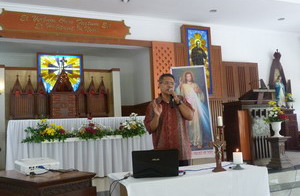
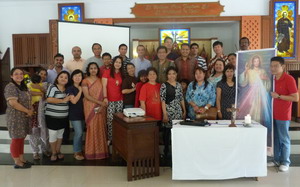
DIVINE MERCY has become a popular devotion that is widely practiced around the world today. The spiritual movement, which is based on the mystical vision of St. Faustina Kowalska, has been introduced to Batam for years and relatively known to many Catholics in this island. Batam even happened to host the Asian Congress of Divine Mercy in December 2007, and consequently a new parish installed shortly afterwards has been dedicated to the Divine Mercy. Since then, the Divine Mercy movement has been widely introduced and adopted in parishes and other communities. The International Pastoral Community(IPC), however, has not systematically adopted this spiritual movement into the pastoral program of the community, even though it is individually practiced. Therefore, the chaplain of the community, Fr. Aurelius Pati Soge, SVD, initiates a more intensive study. Organised by Ms. Nur Rahayu Pujiastutik, the first teaching takes place on Sunday, January 26, 2014, at Bible Centre, Sukajadi. The first of the three steps In a recent Asian Congress on Divine Mercy in Jakarta, it is widely accepted that the devotion, which is based on the mystical spirituality of St. Faustina, should lead people of God to know Jesus better, as portrayed in the Holy Scripture, sacraments and ministries. Therefore, in her visit to Batam, the General Secretary of Divine Mercy Asia, Mary Anawim, emphasised three subjects: (a) Divine Mercy in the Scripture, (b) The Spirituality of the Divine Mercy, and (c) Ministries of Divine Mercy. This first teaching is actually the first step taken to implement it. Entitled "A Covenant Relationship In God's Merciful Love", Fr. Pati Soge presents some biblical roots of Divine Mercy, both in the Old Testament and New Testament. Using stories from Genesis: Adam and Eve, Cain and Able, Noah's Ark and The Tower of Babel, participants are led to discover the consistency of loving presence of God. Men commit sins and consequently they deserve punishment, yet God's mercy is always there to prove that God the Righteousness is full of compassion and mercy. He does not abandon his creation. |
||||
The transition Although the image of God in the Old Testament tends to be strongly retributional (if you do good you are rewarded, if you do wrong you are punished), God's revelation through the Prophet Hosea presents a transition to the fullness of the Divine Mercy. God orders Hosea to marry a prostitute as a model how God loves his unfaithful people of Israel. In this passage, there are three key points: (1) God's unconditional love, (b) God's life-giving sacrifice, and (c) God grants liberty to mankind. For all these great things God gains nothing but human salvation. Here the transition happens: from God of justice and conditional mercy to God who brings justice through unconditional mercy. This approach is fully implemented by Jesus, the Incarnate Word, the fullness of God's revelation throughout the history of humankind. It is brilliantly summed up in Jesus' dialog with Nicodemus, in which Jesus gives the reason of his presence in this world. "God so loved the world that he gave his only Son that whoever believes in him may not be lost but may have eternal life" (Jn 3:16). This is the fullness of Divine Mercy, the most intimate encounter between God and his creation. From St. Faustina to Biblical Jesus and his real presence in sacraments Apart from the beauty of St. Faustina's mystical experience, Fr. Pati Soge also reminds all participants about the goal of any practice of devotion in the church. As devotions are human way of responding the contemporary revelation of God in certain context, it is important to underline the final goal, that is to know better Jesus, our Saviour. But who is Jesus? The true and pure picture of Jesus is the one that is portrayed in the Holy Bible and his real presence in sacraments. Therefore, a true devotion should inspire people to love more the Word of God (Holy Bible) and Sacraments. Should people feel satisfied with their devotions, it should be questioned again. Devotion is good, rich and fruitful, but it is obligatory. Therefore, being involved in the Divine Mercy movement must be understood as a way for further discovery of the purity of Christian faith in Jesus Christ. (ap) |
||||
All stories by TIRTA WACANA Team except where otherwise noted. All rights reserved. | design: (c) aurelius pati soge |
|||